
Introduction
Modern life has become more convenient than ever. Smartphones, smartwatches, online food delivery, work-from-home arrangements, air conditioning, and constant digital connectivity have transformed everyday life. However, convenience does not always mean better health.
The modern lifestyle has created an interesting contradiction: people may have smartwatches to monitor their health but struggle to find time for exercise, smartphones that keep them connected but interfere with healthy sleep, and access to nutritious food but little time to eat properly.
This raises an important question: Can Ayurveda be integrated into a modern, busy lifestyle without completely changing one’s routine?
According to the ideas presented in the video, the answer is yes. Ayurveda does not require people to abandon their modern lives. Instead, it encourages individuals to make their existing lifestyles healthier, more balanced, and more mindful.
Understanding Ayurveda in the Modern World
There is often a misconception that following Ayurveda means waking up extremely early, spending hours practicing yoga, consuming numerous herbal preparations, or eating only boiled food.
However, Ayurveda is presented as something much more practical. Its fundamental purpose is not to force people to leave their current lifestyle but to help them live it in a healthier way.
The broader objective of Ayurveda is to protect the health of healthy individuals and support the well-being of those who are unwell. This approach places considerable importance on prevention, rather than waiting for illness to occur before taking action.
Preventive healthcare has also become an increasingly important concept in modern healthcare. Maintaining health before serious problems develop can be just as important as receiving treatment after a disease appears.
The Challenges of Modern Lifestyle
Although technology has made life easier, it has also contributed to several lifestyle-related problems.
Long working hours, excessive screen time, sedentary routines, irregular meals, insufficient sleep, and continuous stress can negatively affect overall well-being.
Today, even relatively young adults may experience complaints such as:
- Persistent back or body pain
- Constant fatigue
- High levels of stress
- Poor or insufficient sleep
- Digestive problems
- Unhealthy weight gain
- Lack of physical activity
These issues highlight the importance of maintaining balance in daily life.
The problem is not necessarily modern technology itself. Rather, the problem arises when technology and convenience lead to an imbalanced lifestyle.
Simple Ayurvedic Practices for a Modern Lifestyle
One of the key messages of the video is that incorporating Ayurvedic principles does not have to involve dramatic changes. Small, consistent habits can contribute to a healthier routine.
1. Start the Morning Without Immediately Using a Phone
Instead of beginning the day by checking a smartphone, the morning can begin with a glass of water and a few quiet moments.
The practice encourages individuals to avoid immediately exposing themselves to notifications, social media, emails, and other digital distractions.
A calm beginning can help create a more balanced mindset for the rest of the day.
2. Make Time for Physical Movement
The human body is designed to move, yet modern lifestyles often involve sitting for extended periods.
Going to a gym is not necessarily required. Walking, stretching, yoga, or light exercise can provide opportunities for regular physical movement.
Even setting aside approximately 20 minutes for the body each day can encourage a more active lifestyle.
The important principle is consistency rather than intensity.
3. Maintain Regular Meal Timings
Irregular eating habits are another common feature of modern lifestyles.
Skipping breakfast, having lunch late, or eating dinner very late at night can become routine for people with demanding schedules.
Ayurvedic principles emphasize the importance of eating balanced meals at relatively regular times. Developing consistency around meals can help create a more organized daily routine.
4. Treat Sleep as a Priority
Sleep should not be viewed as a luxury. It is an essential part of maintaining overall health.
A regular and sufficient sleep schedule can support the body’s physical and mental well-being. Modern lifestyles often encourage people to sacrifice sleep for work, entertainment, or excessive screen time, but this can have consequences over time.
Giving sleep proper importance is therefore an essential component of a balanced lifestyle.
5. Adapt to Seasonal Changes
Another important Ayurvedic principle discussed in the video is adapting one’s lifestyle according to the season.
Summer, winter, and the rainy season can place different demands on the body. Therefore, maintaining exactly the same diet and routine throughout the year may not always be appropriate.
The concept of Ahara and Vihara, referring broadly to diet and lifestyle, emphasizes adapting food and daily activities according to circumstances, seasons, and the body’s needs.
Managing Stress and Mental Well-Being
Physical health is only one part of overall well-being. Mental health and emotional balance are equally important.
Stress has become so common in modern society that many people consider it a normal part of life. However, continuous or excessive stress can affect both the mind and the body.
The video highlights several simple practices that may help individuals manage stress, including:
- Meditation
- Deep breathing
- Pranayama
- Walking in natural surroundings
- Taking moments of quiet
- Learning to let go of unnecessary thoughts
An interesting message is that people do not need to remember or control everything. Learning to let go of certain things can also be part of reducing mental pressure.
Health Should Not Begin With a Medical Report
Many people begin paying attention to their health only after receiving an abnormal medical report.
However, health is more than numbers on a report.
Persistent tiredness, poor sleep, digestive difficulties, recurring body pain, or other changes in the body can also indicate that something needs attention.
Instead of waiting for a serious condition to develop, individuals should pay attention to these signals and seek appropriate professional medical advice when necessary.
Preventive care involves listening to the body and taking action before problems become more serious.
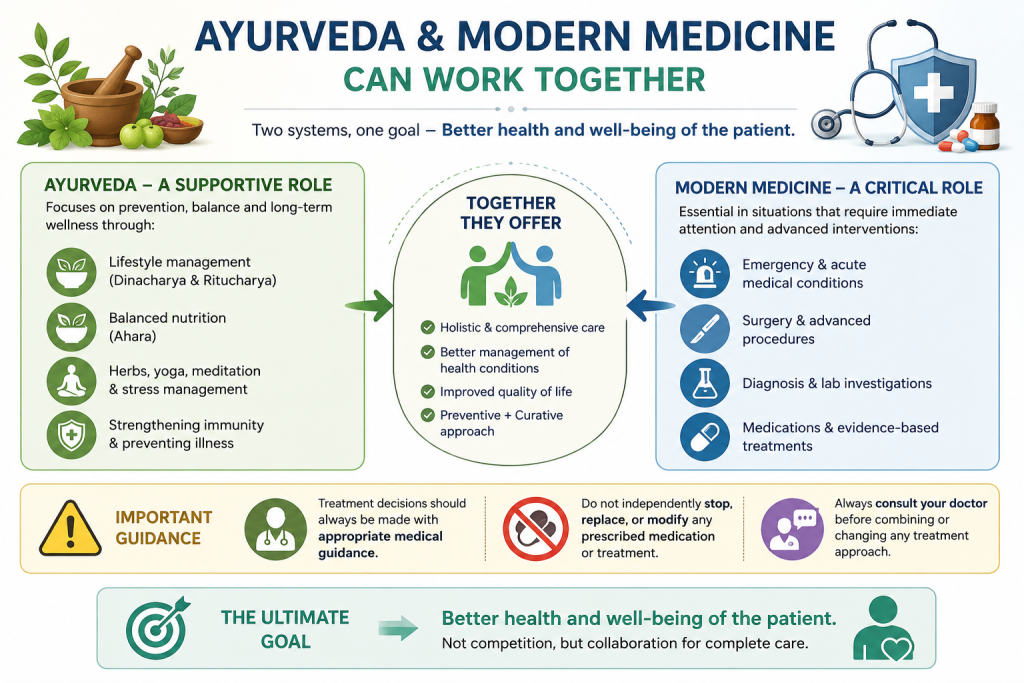
Ayurveda and Modern Medicine Can Work Together
A common question is whether Ayurveda and modern medicine can be followed together.
The video presents the view that, in many situations, both approaches can have their respective roles.
Modern medicine has an extremely important role in emergencies and acute medical conditions. At the same time, lifestyle, nutrition, and certain Ayurvedic approaches may have a supportive role in long-term health management.
However, treatment decisions should always be made with appropriate medical guidance. Individuals should not independently stop, replace, or modify prescribed medication or treatment.
The objective should not be to place one medical system against another. The ultimate goal of healthcare should be the better health and well-being of the patient.
The Five Golden Rules for Better Health
The video summarizes its message through five simple principles:
- Sleep on time.
- Eat on time.
- Move the body every day.
- Manage and control stress.
- Consult a doctor when professional guidance is needed.
These principles are simple, but their consistent application can contribute to a healthier lifestyle.
They also demonstrate that better health does not necessarily require an extreme transformation. Small improvements in everyday habits can become meaningful over time.
Ayurveda: An Approach to Balanced Living
Ayurveda is sometimes perceived as an outdated system that is incompatible with modern science and technology. However, the video presents a different perspective.
Knowledge and understanding evolve as people study, investigate, and evaluate different concepts. Practices that were once poorly understood may become clearer when examined through scientific methods.
The central idea is that Ayurveda should not automatically be viewed as either a miracle or an alternative to modern science. Instead, its principles should be understood carefully and evaluated responsibly.
The discussion also emphasizes the importance of compassion and human connection in healthcare. Not every aspect of healing can be reduced to technology or professional procedures. Emotional support, care, attention, and human connection can also play meaningful roles in a person’s overall well-being.
Technology Can Make Life Easier, but Balance Makes It Better
Technology has undoubtedly improved modern life. Smartphones provide instant communication, smart devices can monitor different aspects of daily activity, and digital services have made countless tasks more convenient.
However, technology alone cannot guarantee good health.
A truly healthy lifestyle requires attention to the body, sufficient rest, balanced nutrition, physical activity, emotional well-being, and appropriate medical care.
The key message is therefore not to reject modern life but to create a healthier relationship with it.
Conclusion
The modern lifestyle does not need to be abandoned in order to embrace Ayurvedic principles.
Instead, Ayurveda can be viewed as an approach toward balanced living—one that encourages people to pay attention to their daily habits, eating patterns, physical activity, sleep, stress levels, and seasonal needs.
The most important lesson is that health should become a priority before illness forces it to become one.
By sleeping on time, eating regularly, staying physically active, managing stress, listening to the body’s signals, and seeking professional medical advice when necessary, individuals can take meaningful steps toward better health.
Ultimately, technology can make life more convenient, but a healthy body and a peaceful mind are what make life truly better.
The goal is not to choose between modern life and traditional wisdom. The goal is to find a sensible balance between the two and build a lifestyle that supports long-term health, awareness, and well-being.
watch the video :