
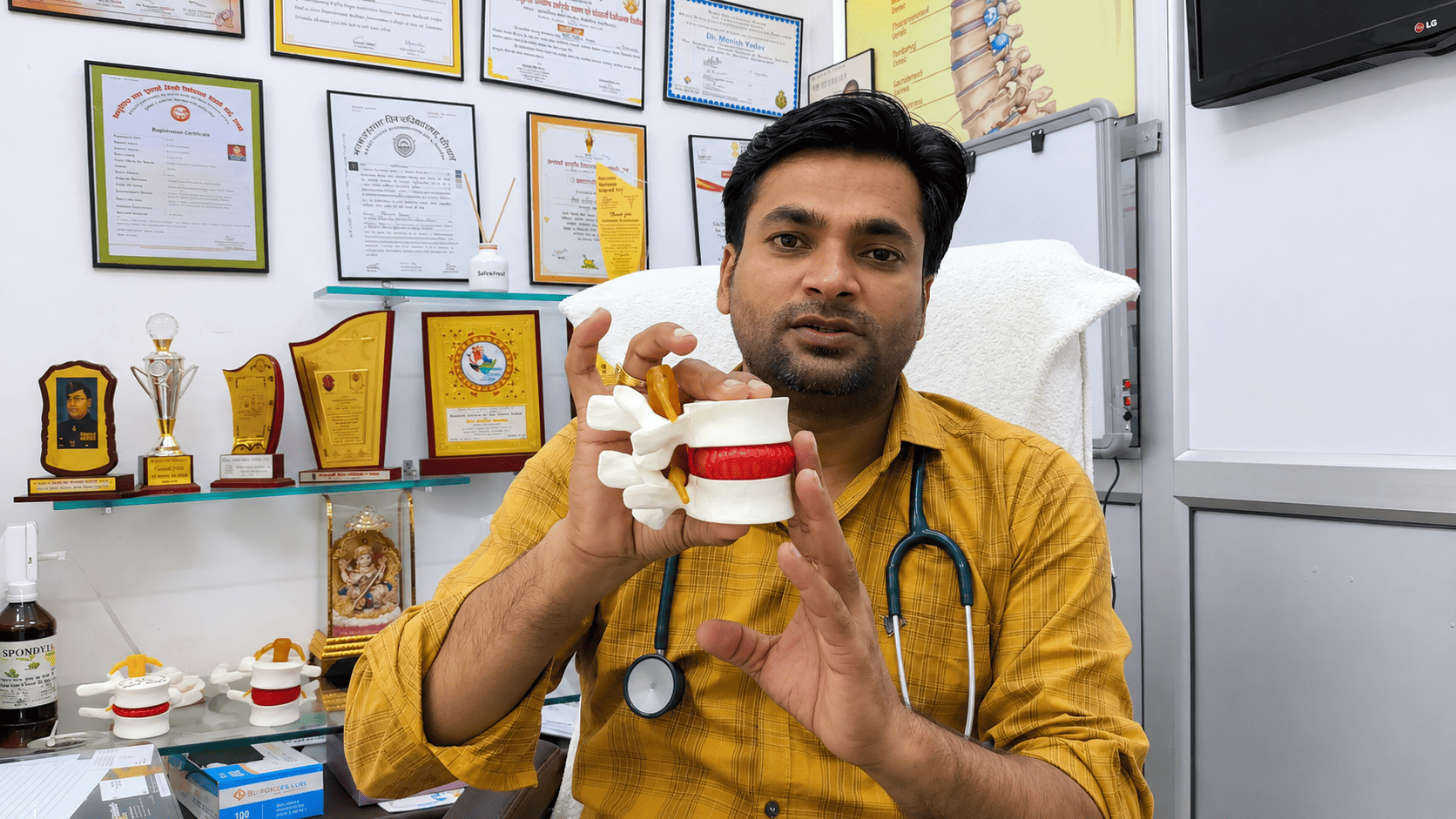
When reviewing magnetic resonance imaging (MRI) reports for chronic lower back issues, patients frequently encounter clinical terms like annular tear and disc protrusion. In a detailed educational video, Dr. Manish Yadav from Rai Shree Ayurveda Spine Clinic in Kanpur breaks down the anatomical structure of spinal discs, explaining how excessive pressure leads to disc wall tearing, material leakage, and persistent back discomfort.
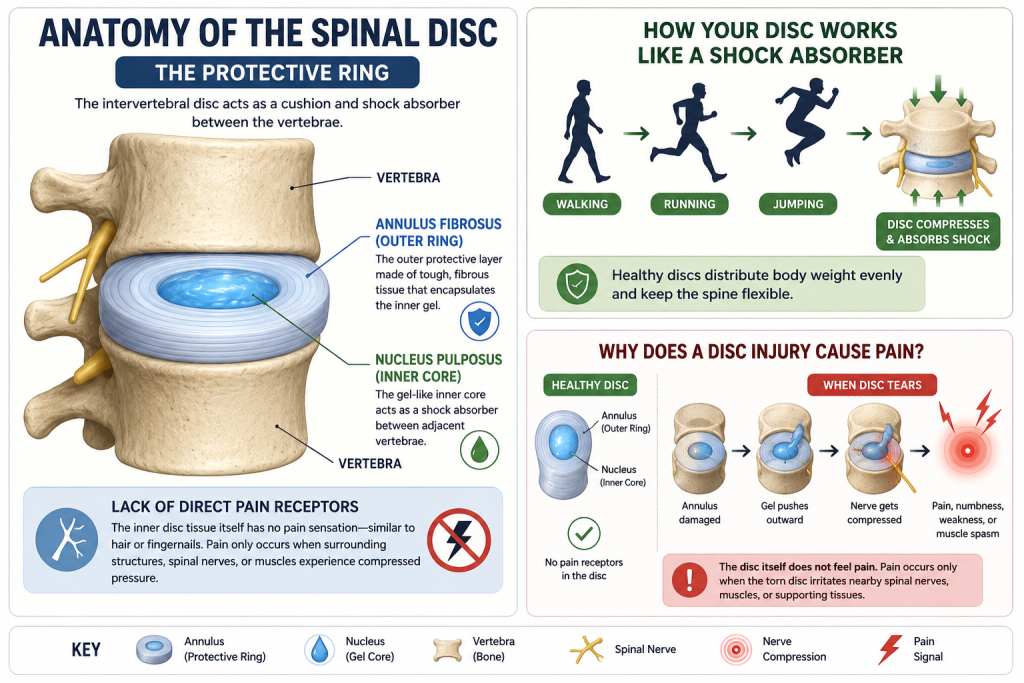
1. Anatomy of the Spinal Disc: The Protective Ring
To understand how spinal injuries develop, Dr. Manish Yadav compares the intervertebral disc to a pressurized structure:
- Annulus Fibrosus (Outer Ring): The outer protective layer of the disc consists of tough, fibrous tissue that encapsulates the soft inner gel.
- Nucleus Pulposus (Inner Core): The gel-like inner core acts as a shock absorber between adjacent vertebrae.
- Lack of Direct Pain Receptors: Dr. Manish Yadav highlights that the inner disc tissue itself has no pain sensation—similar to hair or fingernails. Pain only occurs when surrounding structures, spinal nerves, or muscles experience compressed pressure.
2. How an Annular Tear and Disc Protrusion Occur
When daily strain, heavy lifting, or posture imbalance places excessive pressure on the spinal column, structural changes occur:
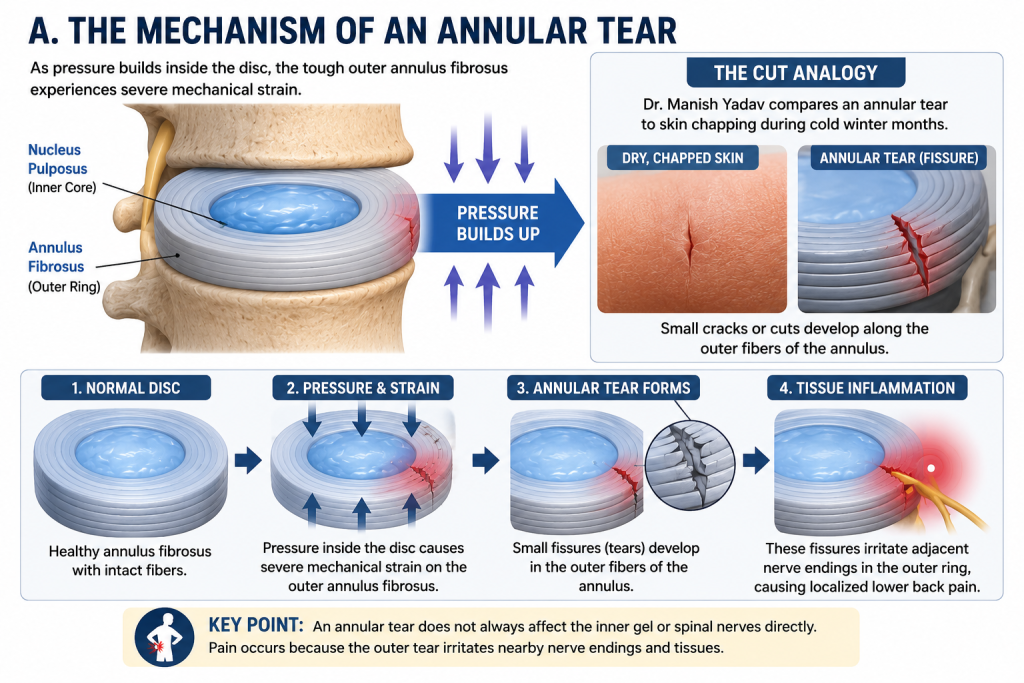
A. The Mechanism of an Annular Tear
As pressure builds inside the disc, the tough outer annulus fibrosus experiences severe mechanical strain.
- The Cut Analogy: Dr. Manish Yadav compares an annular tear to skin chapping during cold winter months. Small cracks or cuts develop along the outer fibers of the annulus.
- Tissue Inflammation: These fissures irritate adjacent nerve endings in the outer ring, causing localized lower back pain.
B. Disc Protrusion and Material Extrusion
When the outer ring tears or weakens significantly under sustained pressure, the inner nucleus pulposus begins to bulge outward.
- Bulging and Pressure: The gel material forms an outward bulge, creating a posterior disc protrusion or a broad based disc protrusion.
- Nerve Compression: When this bulging material pinches nearby spinal nerve roots or surrounding muscles, pain radiates through the lower back and legs.
Annular Tear vs. Disc Protrusion Progression
Spinal Disc Degeneration Stages
| Structural Component | Healthy State | Annular Tear Stage | Disc Protrusion Stage |
|---|---|---|---|
| Outer Ring (Annulus) | Intact, strong fibrous wall keeping inner gel contained | Fissures or cuts appear on the outer wall due to heavy pressure | Wall weakens significantly, allowing gel to push outward |
| Inner Core (Nucleus) | Centrally positioned, absorbing shock evenly | Maintains position but exerts outward force on tear site | Pushes through the weakened wall, creating a localized bulge |
| Nerve & Tissue Impact | No nerve compression or tissue irritation | Localized inflammation along outer nerve endings | Direct compression on adjacent spinal nerves and muscles |
| Clinical Treatment Goal | Preventive posture care | Targeted annular tear treatment & lumbar annular tear treatment | Comprehensive protruded disc treatment to decompress nerves |
3. Treatment Options and Clinical Care
Understanding your MRI findings is the first step toward effective recovery. Non-surgical options focus on relieving internal disc pressure, soothing local tissue inflammation, and restoring normal spinal alignment:
- Annular Tear Treatment: Non-invasive therapies aim to reduce mechanical strain on the outer ring, allowing the fibrous fissure to heal naturally while managing lumbar annular tear treatment.
- Protruded Disc Treatment: Targeted traction, manual spinal adjustments, and specialized Ayurvedic protocols help decompress posterior disc protrusion and broad based disc protrusion, taking direct pressure off pinched nerves.
Key Takeaway
A diagnosis of an annular tear or disc protrusion does not automatically mean permanent disability or surgery. By understanding how internal disc pressure causes outer wall cracks and gel bulging, patients can pursue effective non-surgical care—including annular tear treatment, protruded disc treatment, lumbar annular tear treatment, and specialized management for posterior disc protrusion and broad based disc protrusion—to alleviate spinal nervescompression and achieve lasting back pain relief.
Watch the video: